Most textbook introductions of the model start with a simple division of an economy between households and firms, and I will copy that format here. Following on from that, I’ll illustrate the full circularflowmodel with saving & investment, the government, and foreign trade added in.
The circularflow of income is illustrated in the circularflow model of the economy, which is one of the most significant basic models within economics. This model shows how different units in an economy interact, breaking things down in a highly simplified manner.
The circularflow model relates to various economic indicators, such as GDP, unemployment rates, and inflation. By understanding how money flows between sectors, economists can better analyze these indicators and make informed predictions about economic health.
In the diagram, firms produce goods and services, which they sell to households in return for revenues. The outer circle shows this and represents the two sides of the product market (for example, the market for goods and services) in which households demand and firms supply.
As a fundamental concept of macroeconomics, the circularflow model has been widely applied in different studies, with significant impacts on the understanding of economics. Four examples are listed below to show the significance of the model.
In this article, you’ll explore various examples of circularflowdiagrams that highlight different economic scenarios. From simple models to more complex variations involving government and foreign trade, these diagrams reveal the intricate relationships that drive economic activity.
A visual presentation of the circular flow of income in an economy is called a circularflowdiagram. This diagram illustrates the flow of factors of production, outputs, and money in an economy.
Learn the definition and significance of the circularflow model in economics and how it applies to real life. Understand and be able to apply the circularflowdiagram and chart.
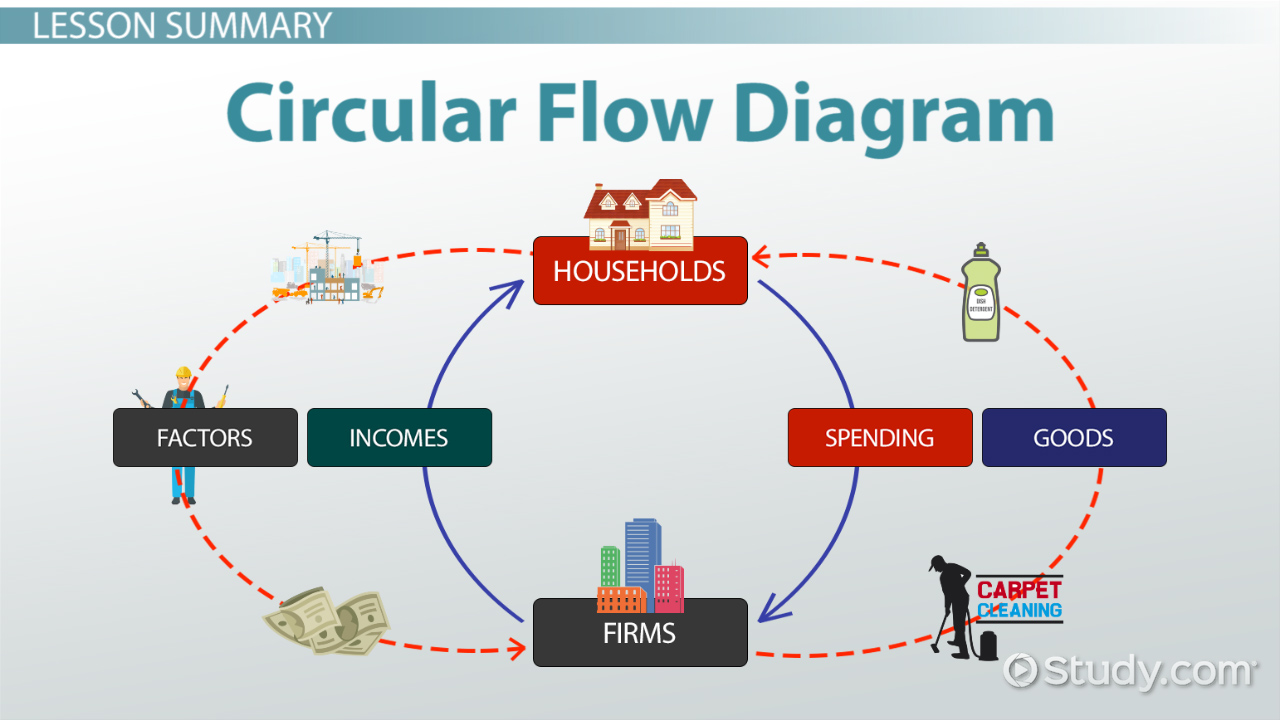 Learn the definition and significance of the circular flow model in economics and how it applies to real life. Understand and be able to apply the circular flow diagram and chart.